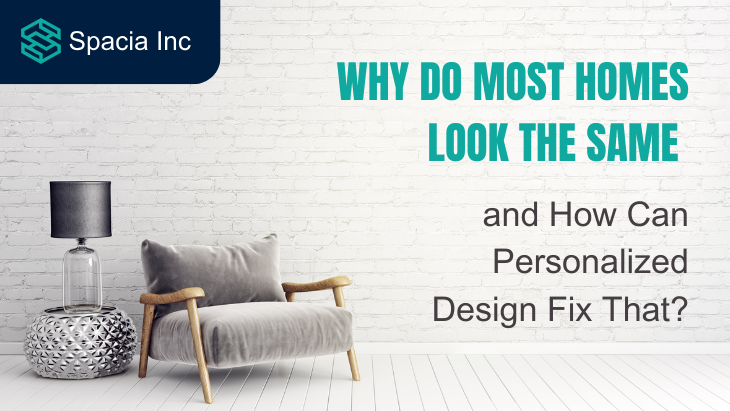



Enter any contemporary neighbourhood nowadays, and you will see something interesting. The houses have a clean, fresh, and very well-conceived appearance, and they are also uncannily similar. It can be a suburban villa, a new apartment house, a house in a gated community; it all comes down to the same colours of the walls, floor tiles are similar, furniture is arranged in the same way, and decor is copied with certain choices painted in the same catalogue.
The question is: Why are the majority of houses similar? And what is even more important, how can individual interior design make that different? Why are most ordinary homes made this way - and how can people who own their own homes escape the trap of standardized and automated design, and begin to express themselves in their design work?
The Rise of “Template Living”
In the recent ten years, real estate has shifted towards mass production. The developers and the builders are concerned with designing homes that are attractive to the largest number of people possible. This means:
- Non-hazardous colour schemes.
- Standardized room sizes
- Pre‑set lighting positions
- In-built wardrobes with the same finishings.
Due to these templates, construction is quicker and cheaper, and a ready-to-move-in appearance is created, which appears to be universally acceptable. However, uniqueness is also not much to be expected with this one-size-fits-all approach.
Result? The majority of houses will be similar to the reflections of the other- even before occupancy.
The social media trends are everywhere.
Such platforms as Pinterest, Instagram, and TikTok have become a global design consultant. Having scrolled through the aesthetic rooms, Pinterest homes, or even viral decor trends, people end up following the same sources of inspiration without even noticing it. This creates a world where:
- We all desire the same beige sofa.
- LED strip lights are fitted in all bedrooms.
- Kitchens are of the same theme, black and white minimalism.
- The same motivational quotes are repeated in the decor of the wall.
Trends can be useful in guidance, but wearing them blindly results in homes that look fancy but soul-sucking, as well as brand new.
The retail stores advertise the same appearance.
Enter any furniture store that is well-known and see a full arrangement that presents a certain theme to sell. The majority of individuals purchase whole sets due to:
- It’s convenient
- It looks good on display
- It feels coordinated
However, the same collections and the same stores that thousands of people purchase mean that their houses echo the same designs. Advancement in manufacturing decor gives the homesteaders a convenient way to fill their houses, but make it difficult to truly make them their own.
Concern about committing design errors.
Lots of homeowners do not want to experiment as they are scared of making a mistake. They adhere to the safe options such as white walls, grey sofas, and neutral decorations since:
- They are concerned with resale value.
- They don’t trust their taste
- There are excessive choices that they face.
- They believe that bold decisions can be considered to look too much.
This fear kills creativity. Safety of playing leads to a finished house, not a self-possessed one. Spaces have been standardized by Lifestyle Changes.
Modernity has brought with it the patterns that were not present before:
- Open kitchens
- Home offices
- Modular storage
- Compact multi‑use furniture
These common functions are also considered when building homes, resulting in the standard layouts and repetitive designs. Although these layouts are functional, they tend to lose creativity.
Then, what can individual design do to correct this?
Although the motives behind homogeneous houses are excusable, the positive aspect is as follows: you do not need to make your home look like that of others. Individual design can make a generic space interesting and meaningful.
Here’s how.
1. Begin With Your Story, Not a Trend.
Individual design starts with knowledge:
- Who are you
- How do you live
- What inspires you
- The atmosphere you desire in your house.
An actual personalizer designer does not begin with Pinterest; he begins with you. A home can be created based on your lifestyle, habits, your travel experiences, your memories, and your values to make it authentic and unique.
Examples: In case you are fond of mountains, your house may be covered with natural textures, tiles with a stone-settling design, warm light, and dull colors. You can have curated pieces and statement colours on your walls if you are an art lover. Your house is a painting and not a duplicate.
2. Mix, Don’t Match
One of the errors that individuals commit is purchasing matched sets. Individual design promotes assortment:
- New + old furniture
- Local crafts + modern decor
- Contrasting colours
- Different textures
- Custom pieces
This mixture adds character and dimension. One handmade table, an aged lamp, or a handmade accent wall is enough to make a space unique at first sight.
3. Wear Colours that portray your mood.
Rather than the beige or white that always fits everywhere, think about the impact of the colours on emotion:
- Soft blues for calmness
- Deep greens for elegance
- Terracotta for warmth
- Mustard yellow for energy
- Charcoal to look classy.
The selection of colours depending on your mood makes you have a home that will be emotionally related to the people who are in the house.
4. Include Custom Furniture.
Individualized works are among the most effective means of breaking the monotony. Custom‑built furniture:
- Fits your space perfectly
- Reflects your tastes
- Provides convenience and features that are lifestyle-friendly.
Personalized furniture, such as a custom dining table or personalized headboard, will bring soul to the mass-produced things.
5. Add Things of Your Culture and Your Roots.
All cultures possess distinct art, designs, and crafts. They are incorporated to provide a feeling of belonging and beauty:
- Indian block prints
- Moroccan tiles
- Japanese minimalism
- Scandinavian woodwork
- African textures
These are components that allow your house to be culturally diverse and of visual distinction.
6. The Exhibit of the Personal Memorabilia.
It is your life experiences that make a home really special:
- Travel souvenirs
- Family photographs
- Books that shaped you
- Collections you’re proud of
- Your own creations and what you have been given.
These are components that bring a warm emotional feeling, something that a trend cannot imitate.
7. Design Round the Way You Live Every Day.
An actual custom design is not merely aesthetically dissimilar, but actually functions differently. In case you like to host, open seating and a warm dining area should be given priority. When you work at home, you should have a motivation office. In case you are a fitness fan, add a fitness nook. And, if you are a reader, create a comfortable reading nest. The home that is based on your lifestyle is functional and fulfilling.
Summary: Your Home Should Tell Your Story.
Houses are identical nowadays as mass production, culture of trends, and convenience have influenced the design style of people. However, a home is not just a building, but it is an inner refuge. Individualized design makes it different. It adds a personal touch to all details, and makes your house:
- More expressive
- More comfortable
- More meaningful
- And truly yours
Once you adopt personalization, you will cease to live in a template.
Conclusion
Spacia Inc. Most homes look the same because people follow defaults – developer templates, retail sets, and social-media trends. It’s quick, safe, and requires zero thinking. But that also means your home ends up looking like everyone else’s.
Personalised design fixes this only if you stop outsourcing your choices to trends and start making decisions anchored in your lifestyle, your story, and your functional needs. A home becomes truly yours the moment you stop copying and start curating. If you want a space with personality, you need to inject your actual personality into it, not whatever Instagram is offering this month.
Q&A Section
1. Why do most homes end up looking identical?
Because people buy whatever’s convenient, “safe”, and already assembled. Developers build for the masses, and homeowners shop from the same stores while following the same Pinterest boards. Uniform inputs create uniform outputs.
2. Is copying trends really that bad?
Copying isn’t the issue — blind copying is. Trends can be an inspiration, but when they dictate every choice, your home becomes generic fast. Use trends as seasoning, not the entire recipe.
3. Is personalisation expensive?
No, what’s expensive is buying an entire showroom set you’ll get bored with in a year. Personalisation can be as simple as:

Leave a reply